Research
Theory
Importance sampling that turns biased simulations into estimates of the original transition rates.
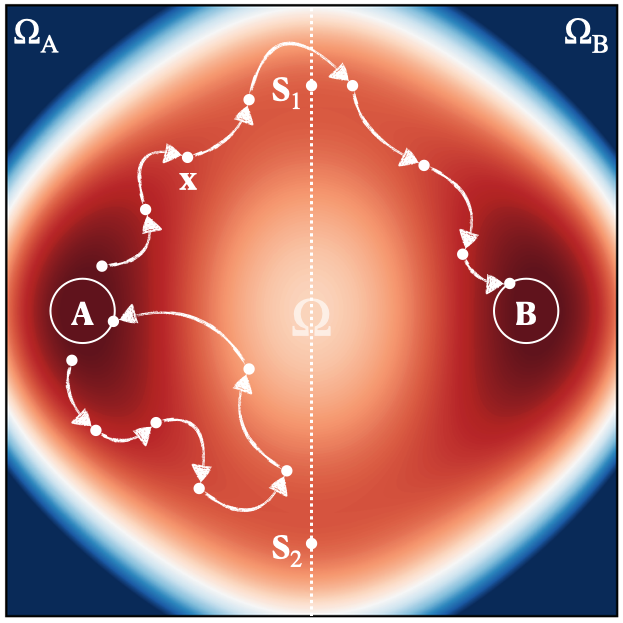
Accelerated Langevin Dynamics
A neural-network importance function tilts each Langevin step toward rare transitions, and path weights absorb its errors, so the success-probability estimate stays unbiased for any positive importance function while a branching random walk keeps the weights bounded.

Accelerated MCMC
A neural network learns a bias potential in log space that steers lattice Monte Carlo through rare transitions, while path reweighting and a branching random walk keep the success-probability estimate unbiased; auxiliary failure and success states keep the formulation robust to grid refinement.
Applications
The methods at work on atomistic and biomolecular rare events.

Accelerated Atomistic Simulations
Neural-network importance sampling of Langevin dynamics reproduces reference rates and resolves competing channels, including an unanticipated long jump, for the LJ7 cluster and, in a revised manuscript in preparation, a Pt adatom on Pt(001) and a vacancy in bcc iron.
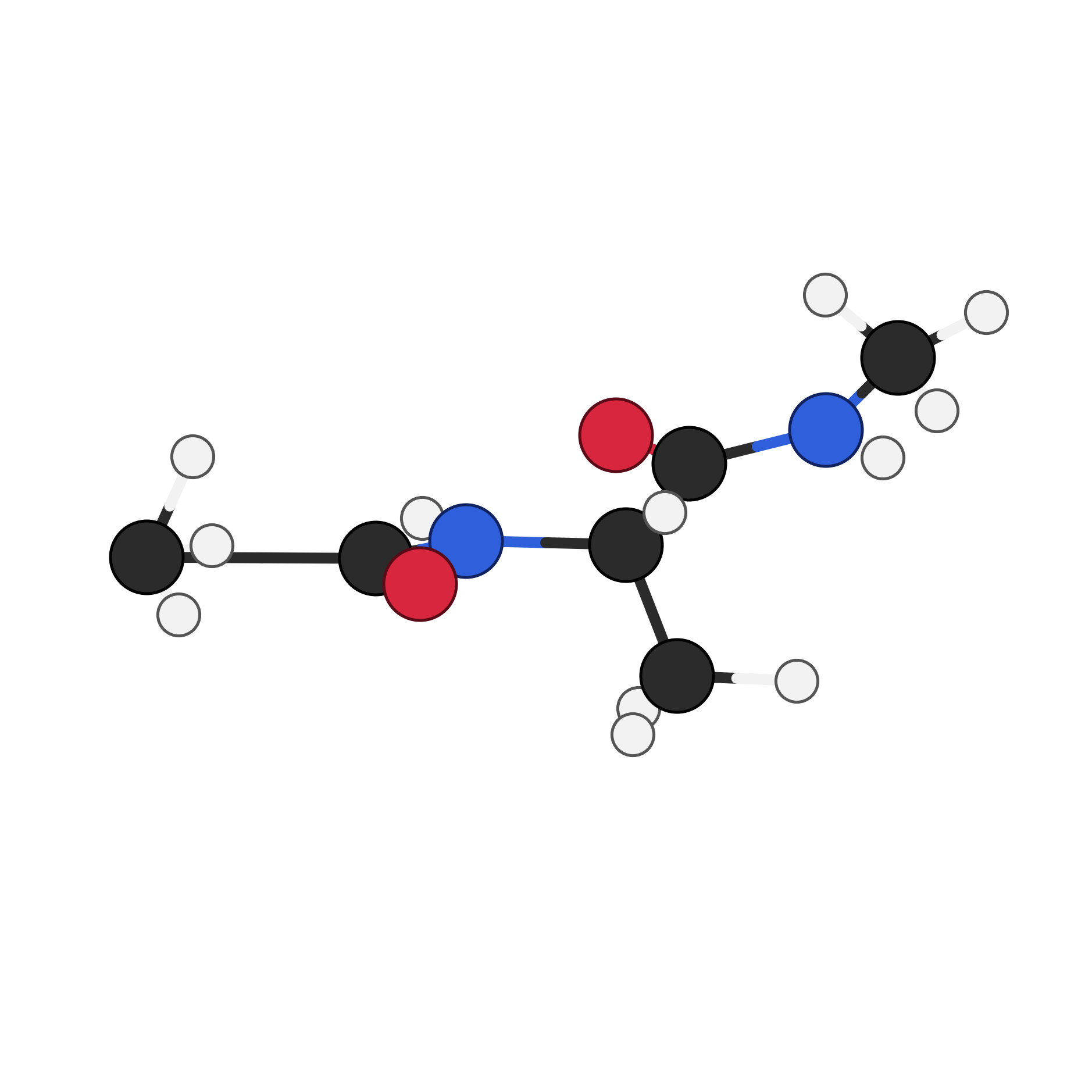
Agent-Guided Variance Reduction for Protein Kinetics
An agentic search driven by Claude Code selects the weight-control scheme that tames path-weight degeneracy, recovering the alanine dipeptide isomerization rate to within 3–6% of brute-force MD.